
Roofing website design
Roofing website design for inspections, repairs, and replacement leads
Help homeowners and property managers decide what to do after a leak, storm, or aging-roof inspection and make the next conversation easy.
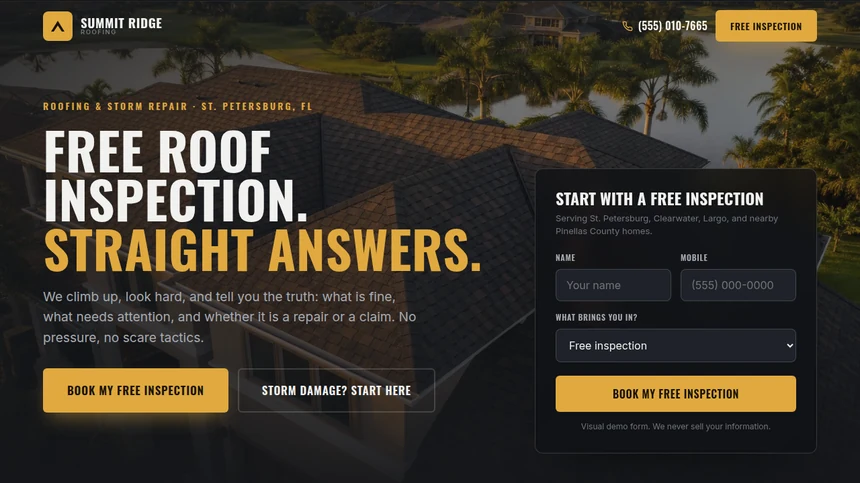
A live roofing site we built. Open the full example →
What roofing customers decide before they call
Almost nobody shops for a roofer casually. They are standing in a bedroom looking at a brown ring on the ceiling, or they just watched a neighbour's roof get tarped after a storm, or an insurance adjuster used the phrase "end of serviceable life" and they are trying to work out what that means for them. Those are three completely different conversations. The leak needs someone today. The storm-damage homeowner needs to know whether to file a claim before they do anything else. The ageing-roof owner is comparing shingle against metal against tile and is nowhere near ready to book. A roofing site that speaks only to emergencies loses the replacement budget, and one that only sells replacements leaves the urgent caller phoning the next company on the list.
What a roofing website has to prove
Roofing carries more risk than most home services, so the site has to answer the quiet worries before the phone rings. Show the licence number and the insurance certificate where people can actually find them, not buried on a legal page. Name the manufacturer certifications you hold, because those are what back an extended warranty. Be explicit about the workmanship warranty and how it differs from the material warranty, since most homeowners assume they are the same thing. Photographs matter enormously here: the roof from the ground, the flashing detail at the chimney, the ridge vent, the tidy driveway at the end of the day. A gallery of trucks and logos proves nothing about the quality of the work.
Turning roofing website visits into booked work
The fastest way to lose a roofing lead is to make an anxious homeowner fill in a long form. Ask for the property address, what they are seeing, roughly how old the roof is, and whether they have photographs or an inspection report already. That is enough to route the request. An urgent leak should reach a phone, not an inbox, so the number stays visible on every screen and the tap-to-call button is fixed to the bottom on mobile. For the replacement enquiries, an option to upload photographs cuts out an entire scheduling round because your estimator can often tell the roof type and rough condition from two pictures.
What we build into every roofing website
Every roofing site we build separates emergency repair, storm and insurance work, inspection, maintenance and full replacement into their own paths, so the visitor self-selects and you learn what the job is before you call back. The quote form captures address, roof type, symptoms, age and storm timing. Photograph upload is built in. The service-area map covers the communities you actually drive to. Financing information sits alongside replacement content, because that is where the payment question surfaces. Reviews are pulled in near the calls to action rather than hidden on a testimonials page, and every enquiry drops into your CRM with the details attached so nothing is retyped.
Where roofing websites usually go wrong
The most common failure is a beautiful homepage that treats a hurricane-season emergency and a planned re-roof as the same enquiry. Close behind it is the stock-photo roof that clearly is not in Florida, on a house that is clearly not local. Sites that hide pricing entirely make people bounce, while sites that publish a fixed per-square price get pinned to a number before anyone has seen the deck. The honest middle ground works better: explain what drives the cost, what a typical range looks like, and what an inspection settles. And an enquiry form that asks for a preferred appointment time before it asks what is wrong tends to collect appointments for problems you cannot actually solve that day.
roofing website design for the Tampa Bay area
Roofing in the Tampa Bay area is shaped by things that do not apply in most of the country. Wind-mitigation inspections can lower an insurance premium, so homeowners search for them by name. Salt air along the coast in Clearwater and St. Petersburg treats fasteners and flashing differently from inland Brandon or Lakeland. Storm season concentrates demand into a few frantic weeks, and permitting runs through a different office depending on whether the property sits in Hillsborough, Pinellas or Polk. A site that names those realities reads as local, and it also happens to match what people actually type into Google around here.
Want a roofing site like this?
We design, build and host it, and you approve it before it goes live. $97/month, setup waived.
Start my $1 trial →Roofing website design questions
Should a roofing website show prices?
Publishing one fixed price per square tends to backfire, because the number gets quoted back to you before anyone has looked at the deck. What works is explaining the variables plainly: roof size and pitch, material, layers to tear off, deck condition and access. Give a realistic range, say what the inspection settles, and most homeowners are satisfied that you are being straight with them.
How do I handle storm and insurance enquiries differently?
Give them their own path. Someone with storm damage needs to know what to document, whether to file before or after an inspection, and what your role is in the claim. Mixing that into a general repair page means they leave to search for the answer somewhere else.
Do I need photographs of my own work?
Yes, and they matter more here than in almost any other trade. A homeowner cannot climb up and check your flashing, so the photographs are the evidence. Include the details as well as the wide shots, and show the property left clean at the end.
Can customers send photographs through the site?
Yes. Photo upload is built into the quote form. Two pictures of a ceiling stain or a missing shingle usually tell your estimator the roof type and rough severity, which often removes an entire scheduling call.
Will the site help me get found for wind mitigation?
It will if we build a page for it. Wind mitigation, roof inspections and insurance-related searches are their own queries in this market, and folding them into a general services page means you rank for none of them.
What happens to an enquiry after hours?
It lands in your CRM immediately and triggers a text and email alert. Urgent calls still go to your phone, but the after-hours web enquiries are queued with the address, photographs and symptoms attached so the first call back in the morning is already informed.
Try everything for $1
The full CRM, the website, AI follow-up in English or Spanish, and your Meta ads tracked. 7 days for $1, then $97/month. No setup fee, no contract. Or talk to a person first.
Start my $1 trial →