
Plumbing website design
Plumbing website design for urgent repairs and planned upgrades
Put a reliable next step in front of someone facing a leak, clogged drain, water heater failure, or a plumbing project.
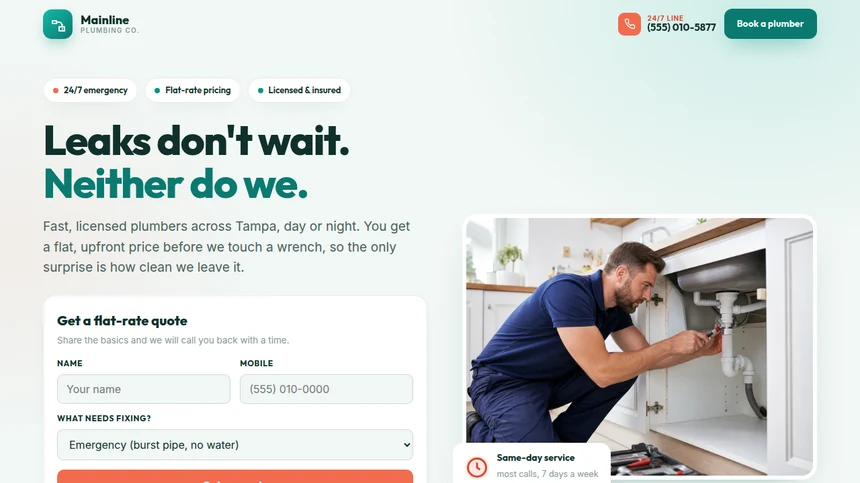
A live plumbing site we built. Open the full example →
What plumbing customers decide before they call
Plumbing splits cleanly between water going somewhere it should not and a project someone has been putting off. A burst supply line or a backed-up main is measured in minutes and the customer will call the first credible number they find. A water heater that is leaking slightly is urgent but not frantic. A repipe, a fixture upgrade or a tankless conversion is a considered purchase with a budget attached. The emergency customer needs a phone number and a promise about response time. The project customer needs to understand options and what drives the cost. Serving both without confusing either is the whole design problem.
What a plumbing website has to prove
Plumbers are let into homes and given access to water systems, so licensing and insurance need to be visible rather than implied. Say whether your technicians are background-checked, because people notice. Flat-rate pricing versus hourly is worth explaining plainly, since that is where distrust usually starts. Emergency response time should be a specific claim you can keep, not a vague promise of speed. Photographs of finished work, clean solder joints, tidy water heater installations and protected flooring, all suggest what the visit will be like. Reviews that mention punctuality and cleanliness carry disproportionate weight in this trade.
Turning plumbing website visits into booked work
For emergencies the phone wins and everything else is friction, so the number is fixed on mobile and stated with your hours. Give the form a short path for non-emergencies: address, what is happening, and whether the water is currently shut off. That last question routes the call correctly more often than anything else. Project enquiries convert better with a scheduled estimate than an instant quote, because customers know a repipe cannot be priced blind. Offering photograph upload helps for fixtures and water heaters, where a picture of the unit and its label tells you the model and age immediately.
What we build into every plumbing website
The site separates emergency plumbing, drains and sewer, water heaters, repiping and fixture work, each with an enquiry path that collects what that job actually needs. Emergency requests carry a shut-off question and route to phone. Water heater enquiries ask for a photograph of the unit label. Service-area pages cover the communities you serve. Reviews sit near the calls to action. Everything lands in your CRM with the job type tagged, so a two-in-the-morning main line backup is never sitting in the same queue as a bathroom remodel enquiry.
Where plumbing websites usually go wrong
The most expensive mistake is a phone number that requires scrolling on a phone while someone is standing in water. After that: refusing to say anything about pricing structure, which sends careful customers elsewhere; a single generic contact form for every kind of job, which strips the information your dispatcher needs; and stock photography of gleaming pipes that plainly is not your work. Many plumbing sites also promise twenty-four-hour service without saying what actually happens at three in the morning, which erodes trust the first time someone finds out the hard way.
plumbing website design for the Tampa Bay area
Older Tampa neighbourhoods still have cast iron and galvanised lines that fail in predictable ways, which is why repipe and sewer searches run high here. Hard water is a real and common complaint across the Bay area, so softener and water quality content earns its place. Slab foundations are the norm, and slab leaks are their own search with their own anxiety. Heavy summer rain drives sewer and drain backups into seasonal spikes. Naming these conditions and the counties you cover reads as genuinely local to a homeowner and matches the way people search here.
Want a plumbing site like this?
We design, build and host it, and you approve it before it goes live. $97/month, setup waived.
Start my $1 trial →Plumbing website design questions
Should I advertise twenty-four-hour service?
Only if you genuinely answer at three in the morning. Advertising it and then routing to voicemail damages trust more than not offering it. If your after-hours coverage is limited, saying so precisely is better than a promise you cannot keep.
Flat rate or hourly, and should the site say?
Say which you use and why. Customers are not upset by either model, they are upset by not knowing. Explaining it plainly removes the main source of suspicion before the technician arrives.
How do I keep emergencies from getting stuck in a form?
Route them to the phone. The number stays fixed on mobile, and the form asks early whether water is currently running, which lets us send true emergencies straight to a call.
Is a water heater page worth having on its own?
Yes. It is one of the highest-intent searches in the trade and the customer is usually deciding between repair and replacement. A page that addresses that choice captures work a general services page misses.
Can customers send a picture of the unit?
Yes. A photograph of the label gives you the model, capacity and age immediately, which often turns two calls into one.
How quickly do I hear about a new enquiry?
Immediately. Every submission triggers a text and email and lands in your CRM with the job type and address attached, so nothing waits for someone to check an inbox.
Try everything for $1
The full CRM, the website, AI follow-up in English or Spanish, and your Meta ads tracked. 7 days for $1, then $97/month. No setup fee, no contract. Or talk to a person first.
Start my $1 trial →