
Remodeling website design
Remodeling website design for better-fit renovation projects
Help homeowners move from inspiration to a realistic remodeling conversation with project galleries, process details, and a useful consultation request.
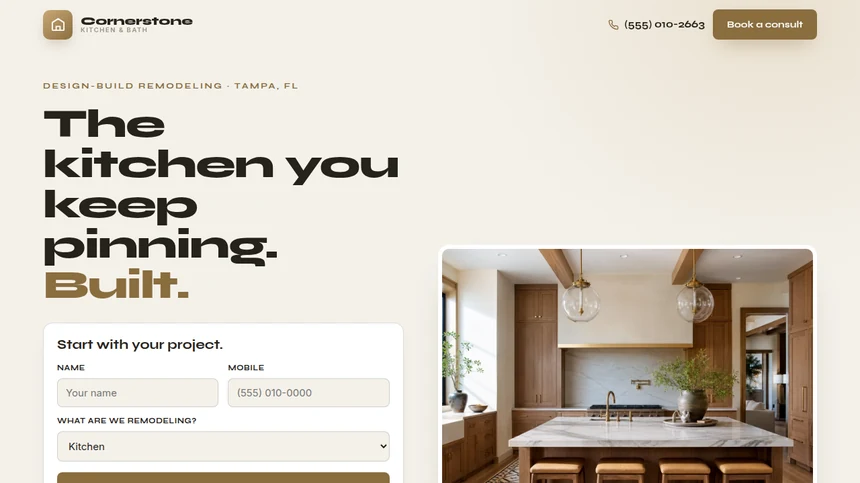
A live remodeling site we built. Open the full example →
What remodeling customers decide before they call
Remodeling has the longest and most cautious buying cycle in residential trades. Someone browses for months, collects images, argues with a partner about budget, and gradually moves from dreaming to scoping. By the time they contact anyone they usually have a rough budget they are embarrassed about and a fear of being talked upward. Kitchens, bathrooms, whole-home renovations and additions are separate journeys with different price expectations. The site's job is to be useful during the long consideration phase, not to close on the first visit, because almost nobody books a remodel from a first session.
What a remodeling website has to prove
The dominant fear in remodeling is not bad workmanship, it is a job that runs long, runs over budget, and leaves the family without a kitchen for months. Address that directly. Explain your process from consultation to design to build, describe how you handle change orders, and give realistic timelines for typical projects. Licensing, insurance and permitting should be explicit. Photographs need to be your own completed projects with enough detail to judge finish quality, and before-and-after pairs of the same space are the most persuasive format available in this trade.
Turning remodeling website visits into booked work
Remodeling converts through a consultation, so the site should make that first conversation feel low-risk. Say what happens on the consultation and whether it costs anything. Publishing honest budget ranges for typical kitchen and bathroom projects filters out mismatched enquiries and reassures serious buyers that you will not waste their time. Ask for the project type, rough scope, budget range and timeframe. A financing option presented near budget content catches people who assumed the project was out of reach. Photograph upload of the existing space helps enormously.
What we build into every remodeling website
The site is organised by project type, kitchens, bathrooms, whole-home, additions, because those are the searches and the budgets differ wildly. Each carries a real portfolio with before-and-after pairs. The process is laid out step by step with timelines. Budget guidance is published as ranges. The consultation request collects project type, scope, budget band, timeframe and photographs. Financing sits alongside budget content. Leads land in your CRM tagged by project type and budget band so follow-up matches the opportunity.
Where remodeling websites usually go wrong
Refusing to discuss budget at all is the standard error, and it filters out serious buyers while attracting people whose expectations you cannot meet. Portfolios of clearly borrowed images destroy credibility in a trade where customers study photographs closely. Sites that never explain the process leave the timeline and change-order fears unanswered, which is what actually stops people booking. Treating a bathroom refresh and a whole-home renovation as one enquiry wastes everyone's time. And no follow-up sequence is costly here, because the buying cycle is long and the winner is usually whoever stayed in touch.
remodeling website design for the Tampa Bay area
Tampa Bay's housing stock spans mid-century bungalows in Seminole Heights, waterfront properties in Pinellas, and newer construction inland, and each brings different renovation realities. Older homes surface knob-and-tube wiring, cast iron drains and settling issues once walls open, which is exactly where change orders come from, so explaining that in advance builds trust. Permitting differs across Hillsborough, Pinellas and Polk. Coastal properties face elevation and flood considerations. Hurricane-rated windows and doors are a common remodeling upgrade here that simply is not a factor in most markets.
Want a remodeling site like this?
We design, build and host it, and you approve it before it goes live. $97/month, setup waived.
Start my $1 trial →Remodeling website design questions
Should I publish remodeling budget ranges?
Yes. Ranges filter out mismatched enquiries and reassure serious buyers. Refusing to indicate cost mostly attracts people whose expectations you cannot meet and repels those you want.
How much detail should the process section give?
Enough to answer the real fear: how long it takes, what happens when something unexpected is found, and how change orders are priced. That is what stops people booking.
What makes a remodeling portfolio credible?
Before-and-after pairs of the same space, your own work, with enough detail to judge finish quality. Customers study these closely and recognise borrowed imagery.
Do kitchens and bathrooms need separate pages?
Yes. They are separate searches with different budgets and different decision drivers, and one combined page ranks and converts poorly for both.
Is follow-up important in remodeling?
More than in any other trade. The cycle runs months and the contractor who stays in useful contact usually wins. The CRM handles that sequence automatically.
Should financing be mentioned?
Yes, next to budget content. A meaningful share of enquiries assume the project is unaffordable, and seeing a monthly figure changes the conversation.
Try everything for $1
The full CRM, the website, AI follow-up in English or Spanish, and your Meta ads tracked. 7 days for $1, then $97/month. No setup fee, no contract. Or talk to a person first.
Start my $1 trial →