
Lawn care website design
Lawn care website design that turns yards into recurring routes
Help homeowners find the right lawn service for weekly maintenance, seasonal cleanup, irrigation, and the yard problem they need solved now.
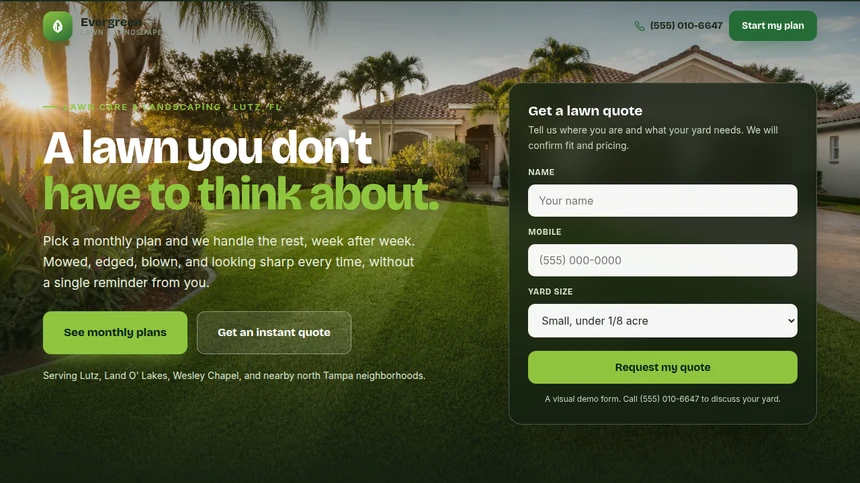
A live lawn care site we built. Open the full example →
What lawn care customers decide before they call
Lawn care customers divide into people who want a problem to stop and people who want to stop thinking about the lawn entirely. The first group has chinch bugs, a brown patch spreading across the St. Augustine, or weeds winning in the swale, and they want a diagnosis. The second group is tired of Saturday mornings and wants a dependable crew on a schedule. That second customer is worth many times the first over a year, but they are also more cautious, because they are choosing someone who will be on their property every week without supervision. The site has to serve the quick fix and earn the recurring contract.
What a lawn care website has to prove
Recurring service is a trust purchase, so show the things that make an unsupervised weekly visit feel safe. Say whether your crews are uniformed, whether the same team returns each week, and what happens if something is missed. Licensing matters if you apply chemical treatments, and homeowners with pets and children will look for it. Before-and-after photographs of real local yards, ideally with recognisable Florida turf, prove more than any claim about quality. Publishing what a service visit actually includes, mowing height, edging, blowing down hard surfaces, prevents the most common source of complaints.
Turning lawn care website visits into booked work
Recurring plans convert best when the pricing model is visible. You do not have to publish a final number, but showing how price is determined, by lot size, service frequency and scope, removes the fear of an inflated quote. Ask for the property address and let the customer pick the plan level they think fits. Instant or same-day quoting on standard residential lots is a genuine advantage, because most competitors take days. For one-off problems, a photograph upload of the affected turf lets you identify the pest or disease before anyone drives out.
What we build into every lawn care website
Your lawn care site presents plans as plans, with what is included per visit and how often, rather than a vague services list. Quote requests capture address, lot size and desired frequency. Photograph upload handles pest and disease enquiries. One-time services like cleanups and mulch are separated from recurring maintenance so they do not muddle the plan pages. Online signup and recurring payment can be built in, so a customer can start service without a phone call. Every lead lands in the CRM tagged by plan interest so follow-up is targeted.
Where lawn care websites usually go wrong
Hiding all pricing is the most costly habit, because the recurring customer is specifically trying to avoid an awkward negotiation. Listing services without explaining what a visit includes generates disputes later. Stock photography of northern fescue lawns is instantly wrong to a Florida homeowner looking at their own St. Augustine. Many lawn sites also make the one-time cleanup and the weekly plan compete on the same page, which confuses both. And no online signup path means every recurring customer has to be closed by phone, which quietly caps growth.
lawn care website design for the Tampa Bay area
Florida lawns are their own discipline. St. Augustine and Zoysia dominate here and they fail in specific, recognisable ways, chinch bugs, brown patch, take-all root rot, and homeowners search those symptoms by name. The growing season runs nearly year-round, so weekly mowing is standard for much of the year rather than seasonal. Water restrictions vary by county across Hillsborough, Pinellas and Polk, and irrigation guidance that acknowledges them reads as genuinely local. Summer rain drives explosive growth and fungal pressure at the same time, which is when most customers finally give up and call.
Want a lawn care site like this?
We design, build and host it, and you approve it before it goes live. $97/month, setup waived.
Start my $1 trial →Lawn care website design questions
Should I publish lawn care prices?
Show the structure even if not the final number. Explaining that price follows lot size, frequency and scope removes the main hesitation for recurring customers, who are usually trying to avoid an uncomfortable negotiation.
Can customers sign up online?
Yes. We can take plan selection, scheduling and recurring payment through the site, so a customer can start service without waiting for a callback.
How do I separate one-time jobs from recurring plans?
Give them separate paths. Cleanups, mulch and sod are different buyers with different urgency, and mixing them into plan pages confuses both audiences.
Do photographs of pest damage help?
Considerably. Chinch bug damage, brown patch and drought stress look different, and a photograph often lets you identify the problem and quote the treatment before sending anyone out.
What should a service page say is included?
Exactly what happens on a visit: mowing at the correct height for the turf type, edging, trimming, and blowing down hard surfaces. Specificity here prevents most future complaints.
Will the site work for commercial properties too?
Yes, and they should have their own path. Commercial enquiries involve different scope, scheduling and contract terms, and folding them into residential pages loses them.
Try everything for $1
The full CRM, the website, AI follow-up in English or Spanish, and your Meta ads tracked. 7 days for $1, then $97/month. No setup fee, no contract. Or talk to a person first.
Start my $1 trial →